
Table tennis tournament modes compared: 26 formats for clubs
From knockout and round robin to Swiss, doubles, team events and multi-stage formats: how clubs can choose the right mode for their field, tables and schedule.
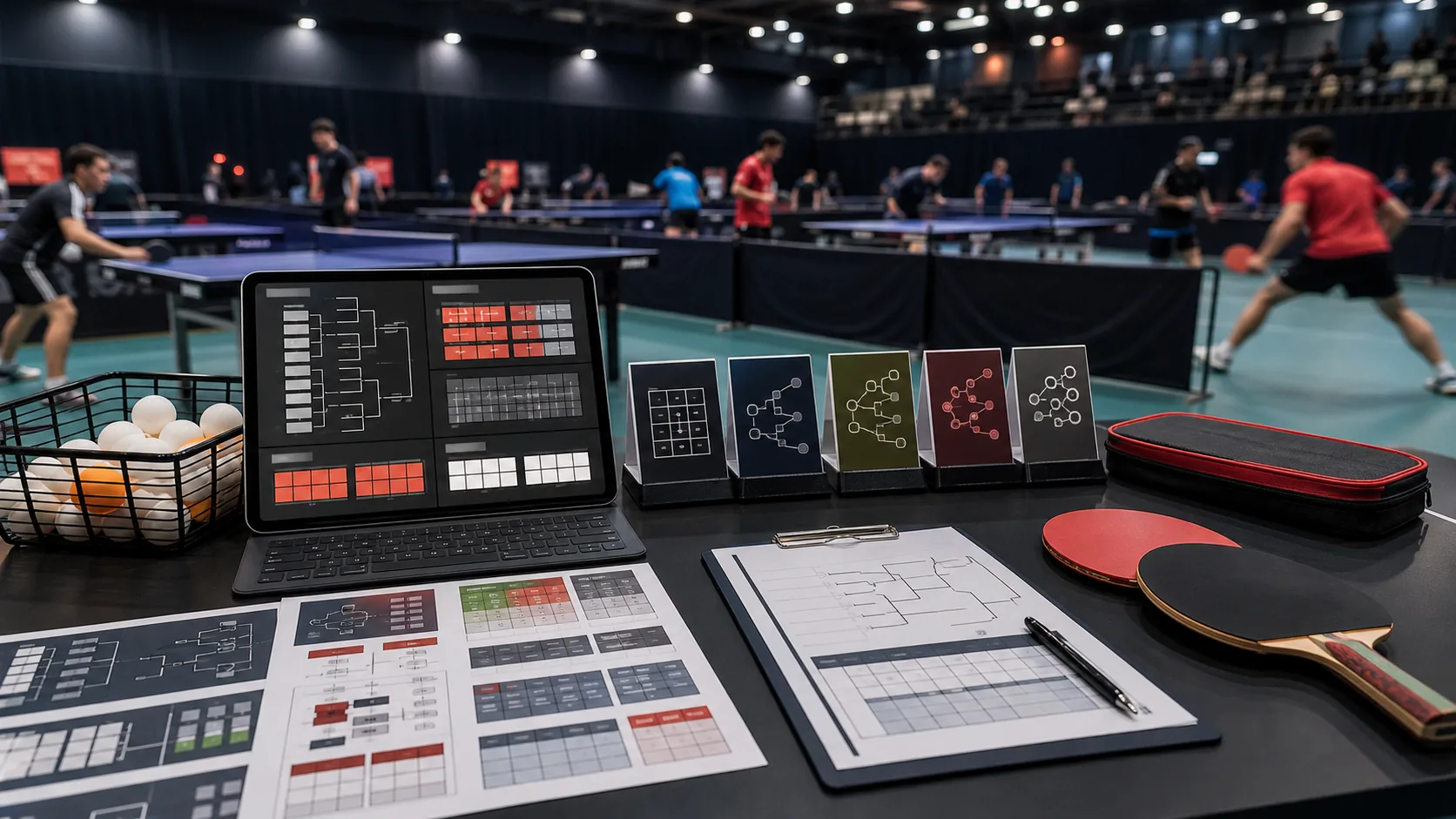
The tournament mode is one of the most important operational decisions before a table tennis event. It defines how many matches will be played, how quickly a winner is found, how much waiting time players must accept and how much control the tournament desk has during the day.
There is no single best mode. A youth event often needs several guaranteed matches, a large open category needs a clear time frame, a club championship can justify placement matches and a team event needs different rules than singles. The right choice depends on field size, table count, helpers, schedule and communication effort.
The following formats are a practical toolbox for clubs. Each one can work well when it is chosen deliberately and explained clearly.
1. Single elimination / knockout
In single elimination, a player or team is out after the first loss. The format is easy to understand, quick to draw and especially useful for final phases, short time windows or large fields.
Fits: open categories with many entries, final rounds after groups, cup events and tournaments with limited venue time.
Risk: One bad start or a tough draw ends the event immediately. For hobby, youth or club-night formats, that often feels too harsh if players get only one guaranteed match.
Organizer tip: Do not use knockout automatically as the whole tournament. It is strongest when a qualification, group phase or seeding step prevents players from being done after a few minutes.
2. Double elimination
Double elimination gives every participant a second chance. After the first loss, players move into a loser or consolation bracket. They are eliminated only after two losses.
Fits: fields where one weak match should not decide everything, but a full round robin would take too long.
Risk: The format is harder to explain than single elimination. The final can need extra explanation if the consolation-bracket winner faces an undefeated player.
Organizer tip: Use double elimination only when the tournament desk can handle bracket logic, table allocation and player communication reliably. The schedule needs more buffer than a simple knockout bracket.
3. Round robin
In round robin, everyone plays everyone. It is very fair because the final ranking comes from several direct comparisons. In small groups, it is one of the best modes for meaningful results.
Fits: club championships, small strength groups, youth groups, hobby events and categories where every player should get multiple matches.
Risk: Match count grows quickly. Six players create 15 matches, ten players create 45. A pure round robin is realistic only for small fields.
Organizer tip: Define tie-break rules before play starts: head-to-head result, set ratio, point ratio or another decision. These rules should be visible before the first match.
4. Group stage plus knockout
Group stage plus knockout is the practical standard for many table tennis tournaments. Players first get several group matches, then the best players advance to a knockout bracket.
Fits: club tournaments, open events with a reasonable match guarantee, youth tournaments and events that want both fairness and a clear final phase.
Risk: Groups need careful sizing. Uneven group sizes, unclear advancement rules or parallel categories can overload the schedule.
Organizer tip: Decide before registration how many players per group are ideal and how many advance. Groups of three or four are often easier to run than very large groups.
5. Swiss system
In the Swiss system, participants play a fixed number of rounds. After each round, players with similar records are paired. Nobody is eliminated early, and stronger players gradually meet stronger opponents.
Fits: larger fields where everyone should get several matches without playing every other participant.
Risk: The format needs discipline. A new round can start cleanly only after the relevant results from the previous round are entered. Players must understand why the next pairing appears only after round completion.
Organizer tip: Communicate the number of rounds and the final ranking criteria in advance. For table tennis, fast score entry and controlled round release are essential.
6. Ladder tournament
In a ladder tournament, players stand in a ranked order and challenge opponents above or near them. After a win, positions can change. The format can work as an ongoing club mode or a longer event block.
Fits: club nights, season rankings, training groups and formats where players schedule matches flexibly.
Risk: Without clear challenge rules, gaps appear: active players move a lot, less active players block positions and some challenges never happen.
Organizer tip: Define allowed challenge distance, deadlines, no-show handling and a rule for inactive players. A ladder is less a classic tournament day and more a controlled ranking system.
7. Compass draw
A compass draw is a multi-path bracket. Winners and losers move into different directions of the draw, such as main, side or placement paths. The advantage is that players continue to receive suitable matches after a loss.
Fits: youth, academy and training competitions where match practice matters more than finding a winner quickly.
Risk: The logic is not self-explanatory. Players need clear displays showing where they move after a win or loss.
Organizer tip: Use a compass draw only when the bracket is visible and well maintained. In the hall, every player should quickly understand which match comes next.
8. Consolation bracket
A consolation bracket is a side event for players who have been eliminated from the main draw. It creates extra matches and keeps participants involved for longer.
Fits: knockout tournaments where one early loss should not end the day.
Risk: Consolation brackets are often underestimated. If they are not planned seriously, they block tables or later run empty because players have already left.
Organizer tip: Decide in advance whether the consolation bracket is played fully, whether there are prizes and until when players must stay available.
9. Ranking and placement matches
Ranking or placement matches determine exact final positions, such as 3rd, 5th, 7th or all places within a category. They make results more complete and can improve the value of club rankings.
Fits: club championships, youth events, selection tournaments and formats with strength groups.
Risk: Not every player wants several placement matches after missing the final. This needs schedule room and clear communication.
Organizer tip: Plan placement matches only as deep as they are useful. A 3rd-place match is easy to explain; a match for 15th place needs a clear purpose.
10. Progressive knockout
Progressive knockout describes formats where the field is gradually split into stronger and weaker paths. Winners stay on an upper path, while players who lose move into placement or side paths. This keeps knockout drama while allowing more participants to stay active.
Fits: events where normal knockout would be too short but full round robin would create too many matches.
Risk: The mode needs good visualization. If players do not understand why they move into a certain path, the tournament desk will spend time explaining.
Organizer tip: Name paths clearly, for example Championship, Placement 5-8 and Placement 9-16. Public views and announcements then stay simpler.
11. Pool system
The pool system splits participants into pools or groups that play internally first. Winners, runners-up or further places then move into new rounds, knockout brackets or placement groups.
Fits: medium and large fields, several strength levels and tournaments with multiple phases.
Risk: Pool is not a complete plan by itself. The important question is what happens after pools and which tie-break rules apply.
Organizer tip: Write the transition logic before the event: who goes where, how points and sets are ranked, and when the next phase starts.
12. Team league format
In a team league format, teams compete in a table. Each team tie consists of several singles and possibly doubles matches. The final ranking can use tie points, match points, sets or points.
Fits: club cups, district nights, training leagues, company events and longer team formats.
Risk: Team formats have more layers: tie, match, set, player, lineup and possibly doubles. A mistake in one layer affects the whole table.
Organizer tip: Decide whether all matches are played or whether a tie stops once it is decided. That changes both schedule and standings.
13. Team knockout format
Team knockout applies knockout logic to teams. One team wins the tie and advances; the other is eliminated or moves into a side event.
Fits: cup days, club duels, short team events and final rounds after a league or group phase.
Risk: A team can include several players who are also active in other categories. This creates conflicts in table allocation and lineups.
Organizer tip: Define lineups, singles order, doubles options and lineup deadlines clearly. The desk should not renegotiate every tie on event day.
14. Mixed team event
A mixed team event combines players across gender, age, strength or role. It can be very attractive socially and sportingly when team composition is fair.
Fits: club celebrations, youth-adult events, hobby tournaments, season closings and inclusive club formats.
Risk: Without clear team rules, teams can become unbalanced. The format must explain which combinations are allowed and how doubles count.
Organizer tip: Use simple rules: for example one stronger and one less experienced player per team, fixed order or one required doubles match. Clear composition prevents arguments.
15. Doubles tournament
A doubles tournament can be played as groups, knockout, Swiss system or a hybrid. The operational difference is that a team consists of two players, and both need to be available at the same time.
Fits: club nights, hobby categories, mixed events, season closings and tournaments where community matters more than a pure singles ranking.
Risk: Doubles create conflicts quickly when players also play singles. Substitutes and late partner changes need rules.
Organizer tip: Do not run doubles beside too many singles categories at the same time. If doubles is a main event, give it its own time window.
16. Fixed doubles
In fixed doubles, pairs register together. This is sportingly clear, good for established partnerships and easy to communicate.
Fits: classic doubles categories, mixed doubles, club championships and open categories with fixed teams.
Risk: Strong pairs can dominate the field. If strength differences are large, consider seeding or rating classes.
Organizer tip: Capture both partners cleanly during registration. Late partner changes should be closed before the draw.
17. Random doubles
In random doubles, partners are drawn. The format is social, relaxed and often popular at club nights because players meet different partners.
Fits: club celebrations, training nights, youth-adult mixing and low-barrier events.
Risk: Pure random pairing can be very uneven. Some players treat that as fun, others see it as unfair.
Organizer tip: Use pots when fairness matters: draw stronger and less experienced players separately, mix age groups or avoid repeated partners.
18. Handicap tournament
A handicap tournament balances strength differences through starting points, changed set lengths or other advantages. A stronger player might start behind, while a less experienced player starts ahead.
Fits: club nights with mixed levels, hobby tournaments, parent-child events and relaxed club formats.
Risk: Handicap rules must be accepted as fair. If the calculation feels arbitrary, every match can trigger debate.
Organizer tip: Keep the handicap table short, visible and fixed in advance. Do not adjust it during the tournament unless that adjustment rule was announced beforehand.
19. Rating-based divisions
Rating-based divisions split players by strength. The rating can come from official values, club rankings, self-assessment or known strength groups.
Fits: larger club tournaments, open events, hobby and performance divisions, and youth formats with very different experience levels.
Risk: Borderline cases are unavoidable. Players just above or below a cutoff can feel disadvantaged.
Organizer tip: Avoid too many divisions. Two or three meaningful strength fields are often easier to operate than many small categories with uncertain minimum sizes.
20. Age-category tournament
Age categories separate players by year or age group, such as youth, adults, seniors or specific junior classes. This creates familiar and fair comparison groups in club sport.
Fits: youth tournaments, club championships, senior events and open tournaments with a clear announcement.
Risk: Small age fields can create too few matches. Multiple entries in age and open categories can overload the schedule.
Organizer tip: Define in advance when age categories are merged. If they are merged, clarify whether awards stay separate or final standings are combined.
21. Giant round robin
A giant round robin is a large everyone-plays-everyone event. It creates a very accurate ranking, but the match count is huge and rarely realistic for a classic one-day event.
Fits: small and committed groups, multi-week club rankings or training leagues where matches can be spread over several dates.
Risk: On a single tournament day, the match volume becomes too high quickly. Players wait for a long time, and unplayed matches distort the table.
Organizer tip: Use giant round robin only with a clear time model: several match days, a fixed deadline or a deliberately small field. For a Saturday in the hall, normal groups usually work better.
22. King of the table
King of the table is a dynamic short format. Winners stay on a table or move up to higher tables; losers move down or rejoin the queue. It often uses short games or time limits.
Fits: training, warm-ups, youth days, relaxed club nights and high-movement events.
Risk: It is less suitable when an official final ranking is required. Without clear rotation rules, queues form quickly.
Organizer tip: Set fixed change times, table direction and scoring rules. For fun formats, simplicity matters more than perfect sporting accuracy.
23. Challenge cup
A challenge cup can be an ongoing challenge competition or a cup with assigned challenges. Players or teams challenge others to win a place, title or rotating trophy.
Fits: club rankings, season activities, club challenges and formats that should hold attention over several weeks.
Risk: The competition depends on activity. If challenges are not played, the cup quickly loses momentum.
Organizer tip: Define challenge windows, acceptance rules, substitution rules and what happens when a match is not played. A challenge cup needs less event-desk effort, but more rule clarity.
24. Best-of series format
In a best-of series format, several meetings between the same players or teams decide the winner, for example best of three matches. This is not the same as a single table tennis match played best of five sets; it is a series at tournament level.
Fits: finals, promotion duels, team duels or small elite fields where randomness should be reduced.
Risk: Series need a lot of time and can be less clear for spectators when other categories are running in parallel.
Organizer tip: Use series formats for a few decisive pairings. For a full large field, the operational cost is usually too high.
25. Multi-stage tournament
A multi-stage tournament combines several phases: registration and seeding, groups, intermediate round, knockout, placement or team phase. Many larger events are multi-stage tournaments in practice.
Fits: larger club and open tournaments, multiple strength levels, qualifications and events with different goals per phase.
Risk: Every phase needs clear transition rules. If one phase ends late, everything after it moves.
Organizer tip: Plan phases operationally as well as sportingly: when are results checked, when is the next phase published, and which players must remain in the venue?
26. Qualification plus main draw
Qualification plus main draw separates a preliminary field from the main event. Players qualify through groups, knockout or Swiss rounds into a stronger main bracket. Seeded players may start directly in the main draw.
Fits: open tournaments with limited main draw capacity, performance categories, seeded cups and events where many participants should get a fair entry path.
Risk: Qualification and main draw can collide if players enter several categories. It must also be clear whether qualifiers are reseeded in the main draw or simply placed into open slots.
Organizer tip: Communicate cutoff, seeding, number of qualifiers and main draw start time early. Qualification must not make the main event unpredictable.
How clubs should choose the right mode
The best choice starts not with the prettiest bracket, but with five questions: How many players are realistically expected? How many tables are reliably available? How many matches should each person be guaranteed? How much time can the tournament desk spend explaining and correcting? And does the event need a fast winner or the fairest possible ranking?
For a short open field, knockout or groups plus knockout often works well. For small club groups, round robin is strong. For larger fields with match guarantees, Swiss can be attractive. For social club nights, random doubles, king of the table or handicap formats work well. Team events need their own tie logic. For ambitious tournaments, multi-stage or qualification plus main draw is often the most robust solution.
Turniero is focused on translating these decisions into controlled tournament operations: categories, registration, draws, tables, live matches, results and public views should all use the same state. The mode is not only a sporting choice; it is an operational promise to players and organizers.

