
Organize a Table Tennis Tournament: Complete Club Checklist
A complete club checklist for goals, dates, venue, categories, registration, draws, tables, scores, communication, and post-event review.
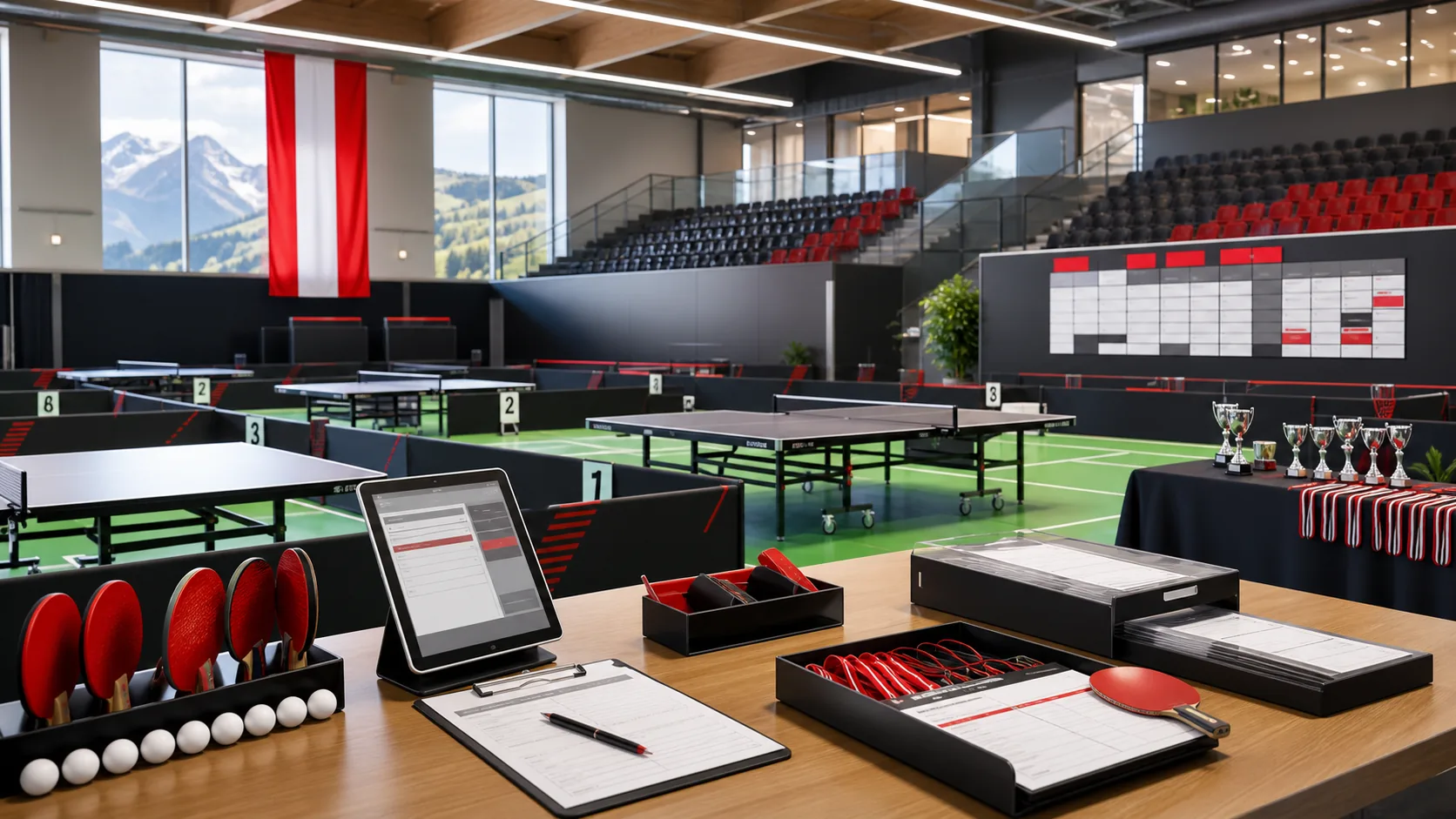
Organizing a table tennis tournament can be one of the best ways for a club to bring players together, attract new members, create visibility, and build a stronger local table tennis community. But even a small tournament can become complicated quickly if the details are not planned properly.
Tables, categories, registrations, schedules, group draws, knockout brackets, score entry, delays, late arrivals, prize ceremonies, and communication all need to work together. A missed detail can easily create confusion during the event.
This checklist is designed for table tennis clubs that want to organize a smooth, fair, and enjoyable tournament.
1. Define the tournament goal
Before choosing the format or opening registrations, the club should clearly define the purpose of the tournament. Is it mainly for club members, an open event for players from other clubs, a youth tournament, a social event, a competitive ranking tournament, or a fundraising event?
The goal affects almost every decision afterwards, including tournament format, number of categories, entry fee, schedule, prizes, and how strict the rules should be. A club-internal fun tournament can be flexible and relaxed. An open regional tournament needs clearer rules, better communication, more accurate scheduling, and stronger match organization.
2. Choose the tournament date early
The tournament date should be selected as early as possible. This gives players enough time to register and gives the organizing team enough time to prepare.
When choosing a date, check league schedules, school holidays, public holidays, other local tournaments, club hall availability, organizer availability, helper availability, and expected player availability.
A weekend is usually best for larger tournaments. Smaller club tournaments can also work on a Friday evening or during regular training hours. For larger events, avoid conflicts with important regional or national table tennis events, because registration numbers may be lower if many players are already committed elsewhere.
3. Reserve the venue and tables
The venue is one of the most important parts of a successful table tennis tournament. Confirm early how many tables are available and how long the hall can be used.
- Number of tables
- Quality and condition of tables, nets, and posts
- Barriers, lighting, and floor condition
- Changing rooms, toilets, and spectator area
- Heating or ventilation
- Parking, electricity, and internet connection
- First aid availability
The number of tables directly affects how many players can participate and how long the tournament will take. Too many players and too few tables can quickly make the event slow and frustrating. The more categories and matches you have, the more important table planning becomes.
4. Decide the tournament categories
Categories should be simple and understandable for players. Too many categories can make the tournament harder to manage, especially for smaller clubs.
Common table tennis tournament categories include men's singles, women's singles, youth categories, age categories, rating-based categories, beginner category, club members only, open singles, doubles, and mixed doubles.
For a smaller club tournament, it is usually better to start with fewer categories and run them well. One open singles category and one beginner or youth category may be enough. For a larger tournament, categories can be separated by age, gender, ranking, or playing level. Every additional category creates more matches, more scheduling complexity, and more work for organizers.
5. Select the tournament format
The tournament format has a major impact on fairness, playing time, and player satisfaction.
Group stage plus knockout
Players are first divided into groups. After the group stage, the best players advance to a knockout bracket. This format is popular because every player gets several matches and the final stage still creates exciting elimination matches.
Round robin
In a round robin format, every player plays against every other player in the same group or category. This is very fair but can require many matches if there are many players.
Knockout only
In a knockout-only format, a player is eliminated after losing a match. This is fast and simple, but it can be disappointing because some players may play only one match.
Double elimination
Players are eliminated only after two losses. This gives players a second chance, but it is more complicated to manage than a normal knockout bracket.
Swiss system
Players play several rounds against opponents with similar results. This works well for larger tournaments where a full round robin would take too long, but it requires careful pairing management.
For most club tournaments, a group stage followed by knockout is often the best balance between fairness, match quantity, and excitement.
6. Set match rules clearly
Before registration opens, the match rules should be clearly defined. Important decisions include best of 3, best of 5, or best of 7 games, points per game, service rules, warm-up time, timeout rules, walkover rules, late arrival rules, injury rules, group tie-break rules, who enters the score, and whether score corrections are allowed.
Most club tournaments use best of 5 games for competitive singles matches. For larger tournaments with limited time, best of 3 can reduce match duration. The key is consistency. Players should know the rules before the tournament starts.
7. Create a registration process
A clear registration process saves a lot of work later. The registration form should collect first name, last name, club, email address, phone number if needed, category selection, date of birth for age categories, ranking or rating if used, doubles partner if applicable, and payment status if there is an entry fee.
The club should also define a registration deadline. This gives organizers enough time to prepare draws, groups, schedules, and table assignments. For open tournaments, a confirmation message after registration reassures players that their entry was received.
8. Decide the entry fee and payment method
If the tournament has an entry fee, communicate the amount and payment method clearly. Common options include cash payment on-site, bank transfer before the tournament, online payment, free participation for club members, and discounted youth entry.
For small club tournaments, cash payment on-site is simple. For larger tournaments, payment before the event can reduce no-shows and make planning easier. The club should also decide whether late withdrawals are refunded and whether players who do not show up still need to pay.
9. Prepare the seeding and draw
Seeding helps avoid having the strongest players meet too early. Seeding can be based on official ranking, club ranking, rating points, previous tournament results, or organizer judgment.
Strong players should be distributed across different groups. Players from the same club can also be separated where possible, especially in open tournaments. The draw should be prepared carefully and ideally checked by more than one organizer before publishing.
10. Build the match schedule
Scheduling is one of the hardest parts of tournament organization. A good schedule considers number of tables, number of players, number of matches, average match duration, rest time, category start times, possible delays, lunch or break times, finals, and award ceremony.
Avoid a schedule that is too tight. Table tennis matches can take longer than expected, especially if many matches go to five games. It is better to plan buffer time than to have the whole event delayed after the first few rounds. For larger tournaments, categories can start at different times to reduce crowding and table pressure.
11. Assign organizer roles
A tournament should not depend on one person doing everything. Useful roles include tournament director, registration desk responsible, score entry responsible, table manager, announcer, equipment responsible, food and drinks responsible, referee or rules contact, award ceremony responsible, and cleanup team.
When roles are clear, decisions are faster and players know who to ask. The tournament director should have final decision-making authority in disputes, delays, or unexpected problems.
12. Prepare the equipment
Before tournament day, check all equipment: tables, nets, barriers, balls, scoreboards, pens, printed match sheets, printed groups and brackets, tape, extension cables, laptop or tablet, charger, printer if needed, first aid kit, cleaning supplies, and microphone or speaker if needed.
It is always a good idea to have extra balls, extra score sheets, and spare nets. Small equipment problems can create unnecessary delays if there are no backups.
13. Communicate with players before the tournament
Good communication reduces confusion on tournament day. Before the event, send players the tournament date, venue address, hall opening time, check-in time, category start times, entry fee, payment instructions, parking information, food and drink information, contact person, important rules, and what happens if a player is late.
The message should be clear and not too long. Players should immediately understand where they need to be and when. For larger tournaments, the club can also publish this information on its website or tournament page.
14. Set up the venue before players arrive
The tournament hall should be ready before players arrive. Setup tasks include placing tables correctly, setting up nets and barriers, numbering tables, preparing the registration desk, displaying groups and schedules, preparing scoreboards, marking warm-up tables if available, setting up food and drinks, checking lighting and floor safety, preparing the award table, and testing laptop, printer, and internet connection.
Table numbers are especially important. Players and organizers should be able to quickly identify where each match is played.
15. Run a smooth check-in
Check-in is the first important moment of tournament day. Confirm player attendance, category participation, payment status, late withdrawals, doubles partners if needed, and last-minute changes.
The check-in desk should be easy to find. If many players arrive at the same time, at least two people should help with registration. A clear check-in deadline helps organizers finalize groups and start on time.
16. Explain the rules before starting
Before the first matches begin, the tournament director should give a short introduction. This can include welcome message, match format, how players find their matches, how scores are entered, table assignment process, warm-up rules, walkover rules, where to ask questions, expected schedule, and award ceremony information.
The explanation should be short and practical. Players do not need a long speech, but they do need clarity.
17. Manage tables actively
Table management is one of the biggest factors in keeping the tournament on schedule. The organizer should always know which tables are in use, which are free, which matches are waiting, which players are missing, and which category is behind schedule.
When a table becomes free, the next match should be assigned quickly. For larger events, it helps to have one person responsible only for table management. This person can call players, assign matches, and update the schedule.
18. Enter and check scores carefully
Score mistakes can create serious problems later, especially in group stages where rankings depend on match results. Scores should be entered immediately after each match.
The club should decide whether players report the result, the winner reports the result, both players confirm it, a score manager enters results centrally, or match sheets are used as backup. For group stages, check standings before moving players to the knockout stage. A wrong result can place the wrong player into the bracket.
19. Handle delays and problems calmly
Even with good planning, problems can happen: players arriving late, no-shows, longer matches, score mistakes, injuries, disputes about rules, table availability issues, technical problems, and last-minute withdrawals.
The key is to have clear rules and calm decision-making. For example, the club should know before the tournament starts how long to wait for a missing player and when to give a walkover. If a delay happens, communicate it clearly.
20. Prepare the knockout stage properly
After the group stage, the knockout bracket must be created carefully. Before starting knockout matches, check final group standings, tie-break calculations, qualified players, seeding positions, avoiding same-group rematches where possible, table availability, match order, possible third-place match, and consolation bracket if used.
The knockout stage is usually the most exciting part of the tournament. It should feel organized and professional. Display the bracket clearly so players and spectators can follow progress.
21. Plan the finals and award ceremony
The final matches should feel special, even in a small club tournament. If possible, reserve one main table for the final and make sure spectators can watch comfortably.
Prepare trophies, medals, certificates, small prizes, sponsor gifts, and photos before the ceremony. The award ceremony should happen shortly after the final so players do not wait too long.
22. Clean up and close the venue
After the tournament, the organizing team should fold and store tables, remove nets and barriers, clean the hall, collect balls and scoreboards, remove posters and printed sheets, pack equipment, clean food and drink areas, check changing rooms, dispose of rubbish, and return keys if needed.
Cleanup is easier if helpers are assigned before the tournament. Otherwise the same few people often end up doing all the work.
23. Publish results after the tournament
Publishing results is important for players and for club visibility. The club can publish final standings, group results, knockout bracket, photos, short tournament report, thank-you message, sponsor mentions, and next tournament announcement.
Results can be shared on the club website, social media, WhatsApp groups, newsletters, or local sports pages. This also helps promote future events.
24. Review what went well and what can improve
After the tournament, the organizing team should do a short review. Ask whether the tournament started on time, whether categories were clear, whether the schedule was realistic, whether there were enough tables, whether players were informed properly, whether scores were entered correctly, whether there were too many delays, whether players enjoyed the format, and whether enough helpers were available.
Write these notes down. They will be very useful for the next tournament.
Club checklist: before the tournament
- Define the tournament goal
- Choose the date and reserve the venue
- Confirm number of tables
- Decide categories and format
- Define match rules
- Create registration form and deadline
- Decide entry fee and payment tracking
- Prepare seeding and draw process
- Build the tournament schedule
- Assign organizer roles and confirm helpers
- Prepare equipment, printed materials, awards, food, and drinks
- Communicate with players
Club checklist: on tournament day
- Open the hall early
- Set up tables, nets, and barriers
- Number all tables
- Prepare check-in desk
- Check attendance, payments, and withdrawals
- Publish final groups
- Explain rules
- Start matches on time
- Assign tables actively
- Enter scores carefully
- Check group standings and knockout bracket
- Manage delays
- Run finals and award ceremony
- Take photos and clean up the venue
Club checklist: after the tournament
- Publish final results
- Share photos
- Thank players, helpers, and sponsors if applicable
- Review problems and delays
- Save tournament data
- Record improvement notes
- Announce the next event
- Update the club website or social media
Common mistakes to avoid
Many tournament problems happen because small details are missed: accepting too many players for the number of tables, creating too many categories, not leaving buffer time, not checking tie-break rules, having unclear score reporting, not assigning roles, starting the draw before check-in is complete, not communicating late-arrival rules, forgetting spare balls or printed sheets, and not publishing results after the event.
Avoiding these mistakes can make the tournament much smoother.
Final thoughts
Organizing a table tennis tournament is not only about creating a draw and starting matches. A good tournament needs planning, communication, table management, score accuracy, and clear responsibilities.
For clubs, the best approach is to keep the first tournament simple. Start with a manageable number of categories, use a clear format, prepare a realistic schedule, and make sure players understand the rules. Once the club has experience, it becomes easier to organize larger and more professional events.
A well-organized table tennis tournament gives players more matches, creates a better club atmosphere, and helps the club grow its community.
Summary shortlist: what Turniero can help manage
- Tournament basics, date, and rules: prepare them in Tournament Setup and Organization Settings.
- Categories, formats, seeding, and draws: manage the operational flow in Categories, keeping participant state and brackets together.
- Online registration, check-in, and participant status: handle them through Registration and the public registration form.
- Manual entry-fee tracking: mark payment status in Payments; online checkout is not part of the current Turniero scope.
- Venue and table planning: support it with Venue Map, table count settings, and Table Control during the event.
- Live matches, match queue, and score entry: run them through Live Matches, score sheets, bulk entry, and correction workflows.
- Player communication and public views: publish key tournament state through the public portal, player view, and paired displays.
- Results, history, and post-event review: use History, Statistics, and reports to check what happened and plan the next event.
- Still manual outside the app: hall booking, equipment transport, catering, awards, photos, external club website posts, and cleanup team coordination remain club responsibilities.

